






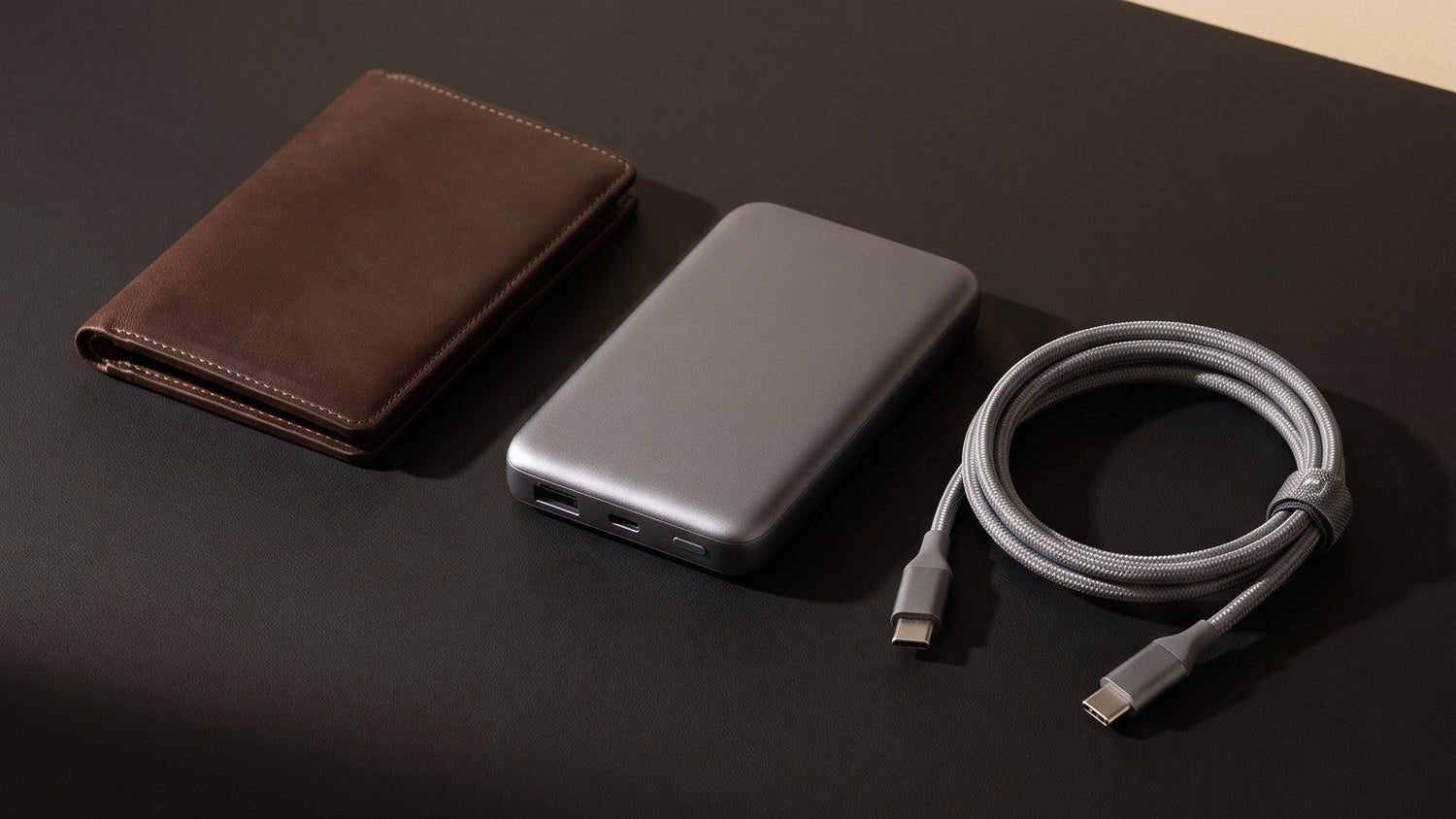
Cabin Only. Always Off.
Four conditions decide whether your power bank flies with you. Work out your watt-hours below, then check it against the 2026 rules.
Yes, you can take a power bank on a flight. It rides in the cabin, stays under 100Wh, is one of a maximum of two, and stays switched off from pushback to gate. Here is the full 2026 rule set, a calculator that settles the watt-hour question in five seconds, and the packs that clear it.
In this guide
- Watt-hour calculator
- The four rules that decide everything
- How the maths works
- Where the power bank has to sit
- What changed in 2026
- Rules by region
- Why power banks get confiscated
- Who makes what, and what to look for
- Five packs that clear the limits
- The pre-flight checklist
- Questions people actually ask
Read The Wh. Then Pack It.
- Hand baggage only. Never in checked baggage, on any airline, anywhere.
- Under 100Wh goes through without approval. That is roughly 27,000mAh at 3.7V.
- Two power banks per passenger is the cap across Indian carriers.
- Using it in flight is banned in India, including charging the bank from an aircraft USB port.
- It sits in the seat pocket or the bag under the seat. Not the overhead bin.
Watt-hour calculator
Screening staff read watt-hours, not milliamp-hours. Put your capacity in and find out where you stand before you get to the belt.
Will your power bank fly?
Enter the capacity printed on the casing. Most packs use 3.7V lithium-ion cells; newer lithium-polymer packs use 3.85V.
Comfortably under the 100Wh limit. Carry it in hand baggage and keep it switched off in flight.
The four rules that decide everything
1. Cabin baggage only
Power banks are prohibited in checked baggage under DGCA, IATA and FAA rules alike. There is no exception, no size below which it becomes acceptable, and no way to declare your way around it. If a bag with a power bank in it gets gate-checked, take the bank out and carry it on.
2. Under 100 watt-hours, or you need permission
| Rating | What happens | Roughly |
|---|---|---|
| Up to 100Wh | Carried freely. Declare at security if asked. | Up to about 27,000mAh at 3.7V |
| 100Wh to 160Wh | Airline approval required in advance, and increasingly refused. | About 27,000mAh to 43,000mAh |
| Above 160Wh | Banned outright. | Above about 43,000mAh |
Air India applies the stricter line and allows only units at or below 100Wh, so the middle band is not worth planning around. Anker states the same cut-off from the other direction on its own support pages: anything under 27,027mAh sits below 100 watt-hours.
3. Two per passenger
Two spare lithium batteries per passenger is the cap Indian carriers work to, and it covers power banks whether they are in your bag or your pocket. A few international carriers go tighter. Emirates and Southwest allow one.
4. No use in flight
The rule most travellers still get wrong. In India you may not charge a device from a power bank in flight, and you may not charge the power bank from the aircraft USB port. It stays off and stays visible. Charge everything at the gate instead.
The one that costs people moneyA power bank in checked baggage is the single most common reason a bag gets pulled off a belt and opened. If you are checking a bag, empty the side pockets before you leave for the airport, not at the counter.
How the maths works
Wh = (mAh × cell voltage) ÷ 1000Almost every consumer power bank uses 3.7V lithium-ion cells. Lithium-polymer packs run at 3.85V, which is why two 10,000mAh banks can be labelled 37Wh and 38.5Wh and both be correct.
| Capacity | At 3.7V | At 3.85V | Status |
|---|---|---|---|
| 5,000mAh | 18.5Wh | 19.3Wh | Cleared |
| 10,000mAh | 37Wh | 38.5Wh | Cleared |
| 20,000mAh | 74Wh | 77Wh | Cleared |
| 27,000mAh | 99.9Wh | 104Wh | At the line, and over it at 3.85V |
| 30,000mAh | 111Wh | 115.5Wh | Approval needed, usually refused |
| 50,000mAh | 185Wh | 192.5Wh | Banned |
The practical takeaway: a 20,000mAh pack is comfortably legal with 26Wh of headroom. Anything advertised above 27,000mAh is a travel problem, however good the price looks, and at 3.85V it crosses the line earlier than the round numbers suggest.
Where the power bank has to sit
Overhead bin storage is now prohibited. The reasoning is blunt: cabin crew need to see and reach a battery that starts venting, and a bag in a closed bin four rows away delays that by minutes. Keep the bank in the seat pocket or in the personal item under the seat in front of you.
Two things follow. Keep it in an outer pocket you can reach without standing up. And keep it out of a sleeve or pouch that traps heat, because a pack you cannot feel is a pack you cannot check.
What changed in 2026
| When | What changed |
|---|---|
| December 2025 | Australia moves first on in-flight use restrictions. |
| January 2026 | South Korea adopts stricter carriage norms. India follows in the first week with the no-use-in-flight advisory. Lufthansa Group aligns from 15 January. |
| 27 March 2026 | The ICAO standard takes effect, making two-per-passenger and cabin-only carriage the global baseline. |
Singapore Airlines, Qatar Airways, British Airways, Cathay Pacific, Thai Airways, JAL, ANA, Korean Air, Qantas and the Lufthansa Group have all aligned. So have the national authorities: CAAS in Singapore, DGCA in India, MOLIT in South Korea, GACA in Saudi Arabia. If you fly anywhere on this list, assume the strict rules apply.
Rules by region
| Region | Capacity | Quantity | Use in flight |
|---|---|---|---|
| India (DGCA) | Up to 100Wh. Air India caps at 100Wh with no approval window. | Two | Banned |
| Singapore (CAAS) | Up to 100Wh | Two | Banned |
| South Korea (MOLIT) | Up to 100Wh | Two | Banned |
| Australia | Up to 100Wh | Two | Banned |
| Europe (Lufthansa Group and others) | Up to 100Wh | Two | Banned |
| United States (FAA) | Up to 100Wh, 100 to 160Wh with approval | Two spares | Airline dependent |
Rules move. Check your operating carrier before you fly, and remember that on a codeshare the rule that applies belongs to the airline whose aircraft you are sitting in.
Why power banks get confiscated
- No printed rating. If the casing does not state Wh or mAh, screening staff have no way to clear it and it does not fly. This is the most common cause by a distance.
- A swollen or dented casing. A pack that no longer sits flat is a pack with a damaged cell. It will be refused, and it should be.
- Loose cells and unbranded packs. Bare 18650 cells and no-name units without safety marking get pulled.
- No safety certification. In India, a BIS registration mark on the unit is what tells staff the pack has been tested to a national standard. Check for it before you buy, not at the gate.
- Over the line. Anything above 160Wh is refused outright, and 100Wh to 160Wh without written approval is refused in practice.
Who makes what, and what to look for
The power bank aisle in India is crowded and the brands are not interchangeable. A quick orientation before the picks.
| Brand | Where it sits | Worth knowing |
|---|---|---|
| Anker | The global volume leader, sold here through Amazon and offline retail | One of the few brands that publishes its own flight guidance and states the 27,027mAh cut-off openly |
| Belkin | Apple-ecosystem accessories, strong on Qi2 and MFi | Lists watt-hours in the retail spec sheet rather than burying it |
| mophie | Premium, heavier builds, long-standing Apple-store presence | Casings are clearly marked and pass-through behaviour is predictable |
| UGREEN | GaN chargers and value-priced power delivery | Good wattage per rupee, less consistent on magnet strength |
| DailyObjects | India, design-led lifestyle tech and everyday carry | Colour and finish are the pitch. Check the watt-hour figure separately |
| Ambrane and Portronics | India, mass-market value across a wide accessory range | Very large capacities appear here first, which is exactly where the 27,000mAh trap lives |
| Stuffcool | India, Apple Premium Reseller channel | Sits beside us on the same shelves, so compare watt-hours and certification side by side |
| MuvTech | India, BIS certified, sold through Aptronix, Unicorn, iDestiny, Reliance Digital and Vijay Sales | Watt-hours printed on the casing across the range |
The only comparison that matters at the gateIgnore the number on the front of the box. Turn the unit over and read the watt-hour figure. If it is not printed there, buy something else.
Five packs that clear the limits
Three of ours that are in stock right now, and two you will already recognise. Every unit here sits under 100Wh, which is the only spec that decides whether it boards with you.

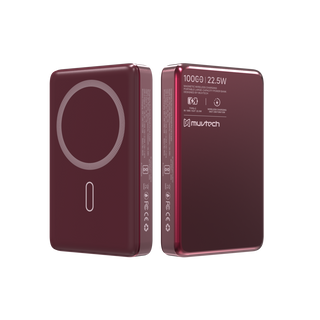
1. MuvTech TANK 20000mAh
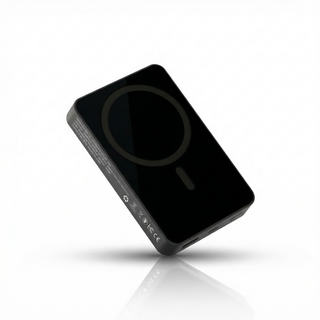
20,000mAh / 74Wh · 15W MagStick wireless · 35W USB-C PD 3.0 · 18W input · Metal and silicone · 349g · 104mm x 68mm
Seventy-four watt-hours prints on the casing, leaving 26Wh of headroom under the limit and settling the conversation at screening. The 35W USB-C output runs a MacBook Air or an iPad, so one pack covers the whole bag. Works with MagSafe and Qi.
₹3,499Shop TANK

2. MuvTech Mini Tank 10000mAh
10,000mAh at 3.85V / 38.5Wh · 22.5W fast charging · Two built-in cables · Digital display · Li-polymer
Thirty-eight and a half watt-hours, printed, with the cables already attached so there is nothing loose to lose in a seat pocket. The display shows the exact percentage left, which is what you want on the leg where you cannot switch it on.
₹1,519Shop Mini Tank

3. MuvTech Slimsonic 10000mAh
10,000mAh at 3.85V / 38.5Wh · 15W magnetic wireless · USB-C in and out · LED percentage display · Li-polymer
Thirty-eight and a half watt-hours in a body slim enough for a jacket pocket, which is where it needs to live once overhead bins are off the table. Snaps to the back of the phone, and the LED tells you what is left without pressing anything.
₹2,199Shop Slimsonic
4. Anker MagGo 10K
Anker publishes its flight position clearly and states the 27,027mAh cut-off on its own support pages, which is more than most brands do. The MagGo 10K series is Qi2 certified and sits well under the line. Widely available in India through Amazon and offline retail.
5. Belkin BoostCharge Magnetic 10K
A 10,000mAh magnetic pack from a brand that lists watt-hours in the retail spec sheet rather than burying it, which makes pre-flight checking a five-second job. Strong Qi2 alignment and a long track record in the Apple channel.
The pre-flight checklist
Questions people actually ask
How many mAh of power bank is allowed on a flight?
Up to roughly 27,000mAh at 3.7V, which works out to just under 100 watt-hours. Anything from 27,000mAh to about 43,000mAh falls in the 100Wh to 160Wh band and needs written airline approval, which Indian carriers rarely grant. Above that it is banned.
Can I put a power bank in checked baggage?
No. Not on any airline, at any capacity, anywhere in the world. Lithium batteries must travel in the cabin so that a fault can be seen and dealt with immediately.
Can I use a power bank during the flight in India?
No. The DGCA advisory in force since early 2026 prohibits using a power bank to charge a device in flight, and prohibits charging the power bank itself from an aircraft USB port. It stays switched off for the duration.
How many power banks can one passenger carry?
Two is the cap Indian carriers apply and the ICAO standard adopted in March 2026. A few international airlines, including Emirates and Southwest, allow only one.
Is a 20000mAh power bank allowed on a plane?
Yes. A 20,000mAh pack is 74Wh at 3.7V, well under the 100Wh limit. The MuvTech TANK prints 74Wh directly on the casing, which is what screening staff look for.
Do I have to declare my power bank at security?
Not proactively in most cases, but take it out of your bag when asked and have the printed rating facing up. Units under 100Wh with a visible watt-hour figure and a safety mark clear screening in seconds.
Where should the power bank sit once I am on board?
In the seat pocket, or in the personal item stowed under the seat in front of you. Overhead bin storage is prohibited so that cabin crew can spot and reach an overheating battery quickly.
Does a MagSafe power bank count differently?
No. Magnetic packs are treated exactly like any other lithium battery. The magnets are irrelevant to the rules; only the watt-hour figure, the count and the cabin requirement matter.
Cleared For Take-Off. Every Time.
Watt-hours printed on the casing, BIS registered, and sized to stay under the line. Charge before you board, and land with something left.
Shop power banks Read the JournalAviation rules change without much notice. Confirm the current position with your operating carrier before you travel, particularly on codeshares and international connections. Figures quoted for MuvTech products are taken from the product specification sheets. Brand descriptions reflect market positioning and are not endorsements. Sources: DGCA advisories reported January 2026, the ICAO carriage standard effective 27 March 2026, and Anker flight guidance.

Leave a comment
This site is protected by hCaptcha and the hCaptcha Privacy Policy and Terms of Service apply.